
Support at Home Program:
Everything You Need to Know
Contents
The Support at Home Program
Has Arrived
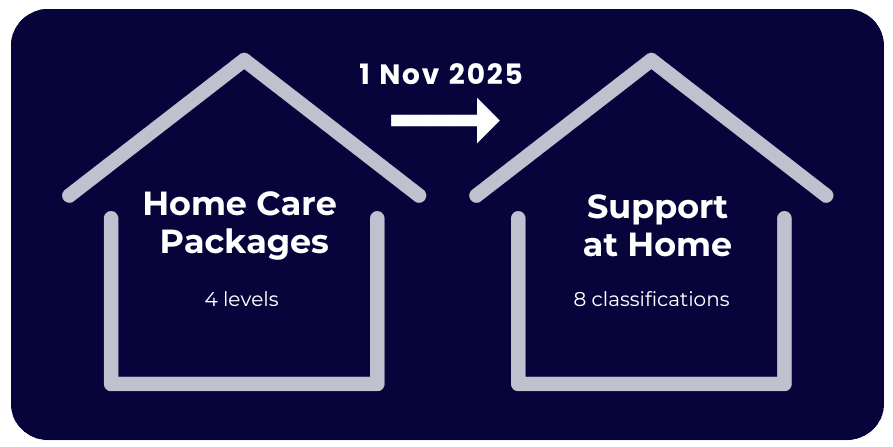
As of 1 November 2025, the Australian Government’s new Support at Home (SAH) Program is now in effect, which offers a simpler, fairer, and more flexible way to deliver aged care services.
This new program is designed to help older Australians live independently, safely, and comfortably in their own homes, with greater choice and control over the support they receive.
At Gratitude Home Care, we’re here to guide you through the changes.
Whether you’re already receiving home care or exploring your options, our Support at Home Hub explains what the new program means for you — and how we can continue to support your care journey with confidence and compassion.
What is the Support at Home Program?
The Support at Home (SAH) Program, launched on 1 November 2025, is part of the Australian Government’s aged care reform. It replaces the previous Home Care Package (HCP) system with a simpler, fairer, and more flexible approach to in-home support.
The new program is designed to make care easier to understand, easier to access, and more transparent when it comes to costs.
Key Changes Under the Support at Home Program:
- All-in-one pricing – administration, care management, and travel costs are now included in your service price
- Capped care management – limited to a maximum of 10% of your total budget.
- No separate package management fees – giving you more clarity and control over your funding.
- Unused funds – up to $1,000 or 10% of your budget can now roll over each year. This
- Separate funding – available for equipment, aids, and home modifications.
- Price caps for services – will be introduced in July 2026 to ensure consistency and value across providers.

For more information, visit:
What This Means for Current Home Care Participants
If you’re already receiving a Home Care Package, you’ll automatically transition to the new Support at Home Program.
- You’ll keep all your unspent funds when moving over to SAH.
- If you had a package prior to November 1, 2025, you won’t be affected by the new $1,000 unspent funds limit. The $1,000 unspent funds limit applies only to new participants who enter the Support at Home program after it begins on 1 November 2025. There is no earlier cutoff date (like November 2024) for this rule, it’s based purely on whether you were already an HCP recipient before the SAH start date.
- ‘No Worse Off’ Principle: If you were already on a Home Care Package on or before 12 Sept 2024, you’ll pay the same or less under Support at Home — even if your needs change later. Otherwise you will have to pay a contribution to your care.
At Gratitude Home Care, our team is here to guide you through the transition — ensuring your care continues smoothly and that you fully understand how these changes benefit you.
Support at Home Transition Dates
& Where You Fit
Support at Home Transition
on or before
12 September 2024
Grandfathered
participants
Automatically transitioned into support at home
Approved OR Assessed
for a Home Care Package, on or before
12 September 2024.
- Unspent funds will carry over.
- If you currently don’t pay HCP fees, you won’t under SAH.
- If you currently do pay HCP fees, you will pay the same or lower contributions under SAH.
- Your current HCP level becomes “Transitioned HCP Level 1-4” with a quarterly budget structure.
after
12 September 2024
Before
1 November 2025
Transitional Participants
Enter Support at Home under the new pricing & contribution arrangements.
- Required to contribute to services (unless approved for hardship).
- Your current HCP level becomes “Transitioned HCP Level 1-4” with a quarterly budget structure.
on or after
1 November 2025
New
Participants
- Full application of SAH pricing, classifications and service model.
- Required to contribute to services (unless approved for hardship).
Three participant pathways exist for the Support at Home transition under Gratitude Home Care. First, Grandfathered participants—those approved before 12 September 2024—will move into the new system with protections to ensure they are no worse off. Second, Transitional participants—approved after that date but before 1 November 2025—will enter under the updated pricing rules. Lastly, New participants—approved on or after 1 November 2025—will follow the full Support at Home application process and will need to make mandatory contributions unless they receive a hardship exemption.
Support at Home Categories
Clinical Care
- Clinical Care is fully funded by the Australian Government.
- Covers essential health and medical services delivered at home.
- Includes:
– Nursing support (wound care, medications, chronic condition monitoring)
– Allied health (physiotherapy, podiatry, occupational therapy, psychology)
– Continence care and nutrition management
- Ensures older Australians receive the professional care needed to stay healthy, safe, and supported at home.
Independence Support
- Independence Support helps older people maintain daily independence and stay socially connected.
- Contributions may apply depending on income and pension status.
- Services include:
– Personal care (showering, dressing, eating)
– Social support (companionship, group activities, tech help)
– Therapeutic services (massage, art therapy, acupuncture)
– Short-term respite
– Transport assistance - Helps seniors stay active, engaged, and confident while remaining connected to their community.
Everyday Living
- Everyday Living provides practical services to keep your home safe, comfortable, and well maintained.
- Includes:
– Domestic assistance (cleaning, laundry, errands)
– Meal preparation
– Minor home maintenance and gardening - Funding may cover:
– Assistive technology (walking aids, wheelchairs, smart home devices)
– Home modifications (ramps, handrails, accessible bathrooms) - Also offers specialised programs such as restorative care and end-of-life support to assist with recovery, rehabilitation, or staying comfortable at home.
What You Need to Know About Contributions
At Gratitude Home Care, we want you to feel informed and confident about your care and any costs involved. If you receive services through the Support at Home program, you may be asked to pay a participant contribution. It’s important to understand that these contributions are set by the Australian Government and administered by Services Australia, not by Gratitude Home Care.
Participant contributions are part of the government’s aged care funding framework. Services Australia assesses each participant’s individual circumstances, including income and assets, to determine whether a contribution applies and how much it may be. These rules are set by the Australian Government and apply consistently across all approved providers.
You can learn more about how aged care costs and contributions are assessed by visiting:
Services Australia – Understanding aged care costs
https://www.servicesaustralia.gov.au/understanding-aged-care-costs-to-get-aged-care-services?context=60049Australian Government – Support at Home Program: Participant Contributions (PDF)
https://www.health.gov.au/sites/default/files/2025-12/support-at-home-program-participant-contributions.pdf
This means:
Gratitude Home Care does not decide whether you pay a contribution
We do not set contribution amounts or rates
Contributions are calculated independently by Services Australia
You only pay contributions for eligible services you actually receive, with the Australian Government funding the remainder
If you have questions about how your contribution has been calculated, Services Australia or My Aged Care are best placed to assist. Our team is also happy to help explain how contributions appear on your statements and support you to navigate the process.
Lifetime Cap
The ‘No Worse Off’ Guarantee
How Much Will You Pay?
Your contribution depends on your financial situation and the type of support you receive:
- Clinical care – Free for everyone
- Independence support – Full Pensioners: 5%, Part Pensioners: 5%–50%, Self-Funded Retirees: 50%
- Everyday living support – Full Pensioners: 17.5%, Part Pensioners: 17.5%–80%, Self-Funded Retirees: 80%
Example (from My Aged Care)
Meet Bill, a retired part Age Pensioner. He owns his home, has modest savings of $10,000, and some superannuation income.
- Total income: $45,500 per year
- Assessed for Support at Home services after 1 November 2025 Under the new contribution model:
- Bill contributes: 14% of his care costs
- Government covers: 86%
Your Status
Clinical Care
Independence
Everyday Living
Full Pensioner
0%
5%
17.5%
Part Pensioner
0%
5%-50% depending on income and assets
17.5%-80% depending on income and assets
Self-Funded Retiree
0%
50%
80%
What do I need to know about Self-Management under SAH?
What Happens Now (Home Care Package)
- Participants can usually suggest or hire their own workers
- Providers have some oversight, but there’s more flexibility
- Worker registration isn’t always required
- Quality and safety are a shared responsibility between the participant and provider
What’s Changing from 1 November 2025 (Support at Home)
- Participants can no longer directly hire their own third-party workers unless the provider approves them
- The provider becomes fully responsible for all workers, including third parties
- All workers must be registered, meet compliance standards, and be approved by the provider
- Providers must decline any worker who doesn’t meet safety or legal requirements
- The provider now carries full accountability for worker compliance, safety, and legal obligations
Why It’s Still Considered Self-Management
Even with these changes, participants will still have choice and control over their care:
- You can continue to help choose your services and how they’re delivered
- You’ll be involved in decisions about your supports and budget
- You can keep using trusted third-party workers, such as cleaners or support staff — they’ll just need to be approved by your provider first to ensure they meet safety and compliance standards
Rideshare inclusion
The voucher system is managed by providers through the Uber for Business dashboard. Providers can set limits such as value, time, and location, and only pay for vouchers when they are used. Clients receive a link by SMS or email, which loads the voucher into the Uber app as a payment method. When booking a ride, the client selects the voucher, and if the fare is higher than the voucher amount, the difference is charged to their own payment method. Providers can see real-time reports of all trips for oversight and compliance.
Uber vouchers are convenient, flexible, and cost-effective. They allow providers to control usage and track spending accurately. However, they require clients to have a smartphone and be confident using the Uber app, which may not be suitable for all. In some areas, there may also be fewer accessible vehicles available.
Cabcharge remains a familiar option, especially for clients who prefer taxis or do not use technology. It does not require a smartphone and taxis may be more readily available in some regions. The downside is that Cabcharge is less flexible, often requires more manual work for reconciliation, does not provide the same level of reporting and taxi trips are usually more expensive.
For participants who are unable to access Uber themselves, there are alternatives solutions. A provider or support worker can book the ride on their behalf using the organisation’s account. Family or carers can also manage bookings with shared vouchers. Some providers may offer a call-in system so clients can request rides directly through the office. Where Uber is not suitable, Cabcharge can be used as a backup option.
End-of-Life Pathway
Eligibility requires a diagnosis from a medical or nurse practitioner confirming three months or less to live, along with an Australian-modified Karnofsky Performance Status (AKPS) score of 40 or below. A completed End-of-Life Pathway form, available on the My Aged Care website from 1 November, is required to begin.
The program provides a mix of fully funded and contribution-based services. Clinical care, such as nursing, is completely covered by the government, ensuring vital medical support comes at no cost to the participant. Everyday living services like cleaning or meal preparation, along with supports for independence, may require a contribution depending on financial circumstances. Assistive technology and certain home modifications can also be included where appropriate.
Support at Home
Detail
End-of-Life Pathway Details
Start date
From 1 November 2025, with the launch of the Support at Home program
Eligibility
Diagnosis of ≤3 months to live by medical/nurse practitioner
Required form
End-of-Life Pathway form, available via My Aged Care
Funding provided
$25,000 for 12 weeks (can be used up to 16 weeks)
Services covered
Clinical supports (e.g., nursing) are fully funded with no participant contributions
Assessment route
High-priority Review via current provider or “Make a Referral” for new users
Continuation options
High-priority Review for ongoing Support at Home
Current Home Care Package Recipients vs Support at Home
Side-by-side comparison: what will change?
Home Care Packages
Support at Home
Assessment
Single Assessment System
(Previously ACAT)
Integrated Assessment Tool (IAT)
Funding
4 Levels
8 Classifications + 2 short-term pathways
Max Funding
Up to $63,440 (Level 4)
Up to $78,106 (Classification 8)
Budget
Annual lump sum
Quarterly budgets; rollover to $1,000 or 10%
Unspent Funds
Must be used within the year
HCP rolled over to SAH “no worse off” policy
Provider Fees
Up to 35% for management
Care management capped at 10%
Income Fees
Up to $35.95 per day
No income test; means-based contribution
Categories
Personal care, domestic assistance, nursing, allied health, transport & more
Clinical Care (100% gov), Independence Supports & Everyday Living
Assistive Tech & Home Mods
Deducted from Home Care annual budget
Separate; immediate funding via Assistive Tech & Home Mods scheme
Short-Term & End of Life
Short-term restorative care (STRC) up to 8 weeks
Restorative up to 12 weeks ($6,000); End of Life up to $25,000 over 16 weeks
Provider Comms
Provider manages care and informs clients
Providers update care; Dept of Health supports transition
Transition
Approved or Assessed on or before 12/09/2024 will be grandfathered
Approved or Assessed after 12/09/2024 will automatically transition
Support at Home introduces significant reforms including a shift from 4 funding levels to 8 classifications plus short-term pathways, increased maximum funding to $78,106, quarterly budgets with rollover provisions, capped care management at 10%, means-based contributions replacing income tests, separate Assistive Technology-Home Modifications Funding (AT-HM), enhanced short-term and end-of-life support, and an Integrated Assessment Tool (IAT) replacing the previous ACAT system.
The 3 New Support at Home Categories
Support at Home provides funding for services that help seniors stay safe, healthy, and independent in their own homes. The program covers medical care, everyday living assistance, and social support, ensuring older Australians can maintain their quality of life while staying connected to their communities.
Clinical Care
Services include
- Nursing
- Occupational Therapy
- Physiotherapy
- Continence Support
- Podiatry
Independence Support
Services include
- Personal Care
- Respite Services
- Social Support
- Transport Services
- Home Safety Modifications
Everyday Living
Services include
- Domestic Assistance
- Gardening
- Home Maintenance
- Shopping & Meal Preparation
The Support at Home Categories Explained
Clinical Care
This category is fully funded by the government and covers essential medical and health services. It includes nursing (like wound care, medication management, and chronic disease support), allied health services (physiotherapy, occupational therapy, psychology, and more), continence support, and nutritional management.
Clinical care ensures seniors receive the professional medical support they need to stay healthy at home.
Independence Support
These services help seniors maintain daily independence and social connections, though some costs may apply depending on income and pension status. Services include personal care (showering, dressing, toileting, and eating), social support (companionship, group outings, and technology assistance), therapeutic services (massage, acupuncture, art therapy, etc.), short-term respite care, and transport options.
Independence support helps seniors live safely and actively while remaining connected to their communities.
Everyday Living
This category covers practical help to keep a home safe and functional. Services include domestic assistance (cleaning, laundry, errands), meal preparation, minor home maintenance, and gardening. It also includes funding for assistive technology (wheelchairs, walking aids, smart home devices) and home modifications (ramps, handrails, accessible bathrooms).
Special programs, like restorative care and end-of-life care, provide extra support for recovery or staying at home in later stages of life.
The 2 New Short-Term Pathways
Restorative Care Pathway
The Restorative Care Pathway helps seniors regain independence with daily activities, supporting them to continue enjoying the things they love and potentially reducing the need for additional services.
Through this program, you can:
- Access up to 12 weeks of restorative care.
- Receive an extra budget of around $6,000 (or up to $12,000 if needed) for allied health services.
- Use restorative care on its own or alongside your ongoing Support at Home services.
- Access assistive technology and home modifications through the Assistive Technology and Home Modifications (AT-HM) scheme if required.
Learn more about the new Restorative Care Pathway and and how it can support your independence, wellbeing, and access to essential aged care services.
End-of-Life Pathway
Through this program, you can:
- Access urgent, higher-level funding for in-home aged care services if diagnosed with three months or less to live.
- Use assistive technology through the Assistive Technology and Home Modifications (AT-HM) scheme if needed.
- Receive up to $25,000 in funding over 12 weeks, with up to 16 weeks to use the funds for flexibility.
If additional services are needed beyond 12 weeks, an assessment can be requested to continue receiving Support at Home services. This pathway complements other in-home palliative care provided by state and territory governments.
You can also learn more about Support at Home’s End-of-Life Pathway here.
Support At Home Classifications
Budget Classifications
One of the biggest changes is how care budgets are now classified — helping ensure every older Australian receives the right level of support for their individual needs.
Here’s a quick breakdown of the eight SAH budget classifications and what they mean:
* Current as at 28 November, 2025
Classification
Quarterly Budget
Annual Budget
Overview of Care Needs & Typical Services
1
$2,682.75
$10,731.00
Low support needs – Occasional help with domestic tasks
2
$4,008.61
$16,034.45
Mild ongoing support – Regular domestic assistance
3
$5,491.43
$21,965.70
Moderate support needs – Regular personal care
4
$7,424.10
$29,696.40
Moderate to high support needs – Frequent personal and clinical care
5
$9,924.35
$39,697.40
High support needs – Daily assistance with personal care
6
$12,028.58
$48,114.30
Very high support needs – Intensive personal and clinical support
7
$14,537.04
$58,148.15
Extensive support – Multiple daily care visits
8
$19,526.59
$78,106.35
Maximum home care support – Equivalent to near full-time care
How do I Apply for Support at Home?
The Single Assessment System was created to make it easier for older people to access aged care services as their needs change.
If you are not already receiving services through My Aged Care, the first step is to check your eligibility for an assessment. You can do this online at My Aged Care or by calling 1800 200 422.
If your application is successful, you will be referred for an in-person assessment at your home
Once assessed and found eligible for the Support at Home program, you will receive a Notice of Decision along with an individual support plan to share with your provider.
Your Support At Home Plan Includes:
- A summary of your aged care needs and goals.
- Your classification, along with the associated ongoing quarterly budget and a list of your approved services.
- Any short-term support approvals, which may include funding for:
- Assistive Technology
- Home Modifications
- Restorative Care Pathway
- End-of-Life Pathway
Support at Home
Eligibility Criteria
To be eligible for a Support at Home assessment, you generally need to:
Be aged 65 years or older (or 50 years or older if you’re an Aboriginal or Torres Strait Islander person).
Have difficulty managing everyday tasks due to age-related factors.
Require support to remain living independently at home.
These criteria are assessed through a two-part process:
These criteria are assessed through a two-part process:
Eligibility Check
You can complete an online eligibility check on the My Aged Care website or call My Aged Care at 1800 200 422.
In-Person Assessment
If eligible, an assessor will visit your home to evaluate your needs and discuss suitable services.
Support at Home Standard
Fees & Contributions
Approved or Assessed for a Home Care Package
AFTER 12 September 2024
From 1 November 2025, participants that were Approved or Assessed a Home Care Package after 12 September 2024 will receive services through the new Support at Home program under the standard fees and contributions model. These participants will not be covered by the grandfathering arrangements and will instead enter the program under the new fee structure for Support at Home.
Under the new arrangements, clinical care services will be fully funded by the government for all participants. Contributions toward independence and everyday living supports will be income-based. Self-funded retirees pay the highest contributions; those eligible for a Commonwealth Seniors Health Card (CSHC) pay lower rates, similar to part pensioners. There is a lifetime contributions cap of $130,000 for non-clinical services under Support at Home.
Some participants may be required to make participant co-contributions for services they utilise. This is determined by Services Australia under the directive of government and My Aged Care. To find out if you are required to co-contribute, contact Services Australia on 1800 227 475.
Learn more: Support at Home Fees & Contributions
Source: Support at Home participant contributions
Full Pensioners
Part Pensioners
Self-Funded Retirees
Support at Home Contribution
Clinical Care
Full Pension 0%
Part Pension 0%
Self-Funded 0%
Services include
- Nursing
- Occupational Therapy
- Physiotherapy
- Continence Support
- Podiatry
Independence Support
Full Pension 0%
Part Pension 5-50%
Self-Funded 50%
Services include
- Personal Care
- Respite Services
- Social Support
- Transport Services
- Home Safety Modifications
Everyday Living
Full Pension 17.5%
Part Pension 17.5-80%
Self-Funded 80%
Services include
- Domestic Assistance
- Gardening
- Home Maintenance
- Shopping & Meal Preparation
Support at Home Grandfathered
Fees & Contributions
Approved or Assessed for a Home Care Package on or
BEFORE 12 September 2024
If you are transitioning from the Home Care Packages Program, anyone who was receiving a package or assessed for a home care package on or before 12 September 2024 will be no worse off under Support at Home. You will pay the same contributions, or lower, than you were assessed to pay under HCP.
If you were assessed as not required to pay fees before that date, you will never be asked to pay fees under Support at Home. The HCP lifetime cap of $82,018 (indexed) will continue to apply. Contributions may still change over time if your assessed care needs or financial circumstances change, when indexation applies to fees and thresholds, or once you reach your lifetime cap. Routine indexation occurs on 20 March and 20 September each year.
Learn more: Support at Home Fees & Contributions
Source: Support at Home participant contributions
Grandfathered
Full Pensioners
Grandfathered
Part Pensioners
Clinical care is fully covered – pay 0%
Independence supports – pay between 0-25%
Everyday living services – pay between 0-25%
Grandfathered
Self-Funded Retirees
Support at Home
Grandfathered Contributions
Clinical Care
Full Pension 0%
Part Pension 0%
Self-Funded 0%
Services include
- Nursing
- Occupational Therapy
- Physiotherapy
- Continence Support
- Podiatry
Independence Support
Full Pension 0%
Part Pension 0-25%
Self-Funded 25%
Services include
- Personal Care
- Respite Services
- Social Support
- Transport Services
- Home Safety Modifications
Everyday Living
Full Pension 0%
Services include
- Domestic Assistance
- Gardening
- Home Maintenance
- Shopping & Meal Preparation

How Gratitude Home Care support you?
Finding the right Support at Home provider doesn’t have to be complicated. Start today and take control of your home care journey.